

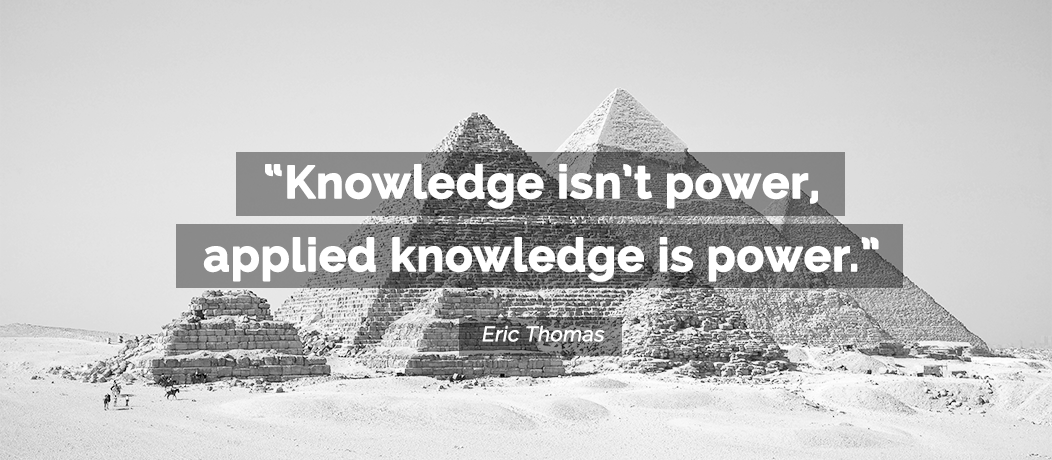
Applied Knowledge Is Power: Why Strategy Fails Without Execution

Knowledge creates potential, but applied knowledge creates results. Information, data, and strategic recommendations only generate value when an organization translates them into effective action.

Modern organizations have access to unprecedented information, analytics, and AI-generated insights. Yet, knowing what to change rarely guarantees progress. Success requires filtering signal from noise, making clear decisions, and driving execution.

What Is Applied Knowledge in Business?

Applied knowledge is the practical application of data, experience, and insights to solve business problems and make strategic choices. Raw information only adds value when connected to clear decision-making and follow-through.

A complete strategic lifecycle follows five key stages:

  • Information: Identifies what is happening.
  • Insight: Explains why it is happening.
  • Strategy: Determines what to do about it.
  • Execution: Converts decisions into action.
  • Measurement: Evaluates the outcome.

6 Barriers to Strategic Execution

Even well-resourced companies struggle to turn strategy into action due to common organizational bottlenecks:

  • Competing Priorities: Good ideas get buried when everything is treated as urgent.
  • Unclear Ownership: Without a designated leader, recommendations remain unimplemented.
  • Organizational Silos: A fragmented view across departments prevents a unified strategy.
  • Legacy Processes: Habitual routines outlast their strategic alignment.
  • Analysis Paralysis: Excessive research replaces definitive decision-making.
  • Capacity Constraints: Teams lack the bandwidth, skills, or tooling for proper execution.

Filtering Information for Strategic Decisions

Gathering more data often creates noise rather than clarity. Effective strategy requires separating critical signals from distractions and focusing only on data that directly informs the decision at hand.

Turning Observations Into Strategic Insights

Strategic insights start as subtle observations like a recurring customer question, a workflow workaround, or a minor shift in competitor positioning. Connect these isolated signals to anticipate market changes and ask: “What does this tell us about what happens next?”

Key Questions a Business Strategy Must Answer

Strategy bridges insight and execution. A practical strategic plan must explicitly clarify:

  • Core Objective: What specific outcome or problem are we addressing?
  • Prioritization: What actions take priority, and what should we stop doing?
  • Accountability: Who explicitly owns the next steps and resource allocation?
  • Measurement: How will we evaluate whether the action succeeded?

The Execution Feedback Loop

Execution tests strategic assumptions against reality. Continuous adaptation relies on an agile feedback loop: Decide → Act → Observe → Measure → Adjust.

How AI Impacts Strategy and Execution

Generative AI makes research, analysis, and plan creation instant. However, AI makes generating options easy while evaluating options remains hard. Human judgment, context, and prioritization are still required to select and execute the right strategies.

Measuring Execution Over Activity

Busywork like meetings, reports, and tool adoption should not be confused with progress. Evaluate execution by asking: “Did this initiative achieve its target business outcome?”

Value of an Outside Perspective

Internal teams can be blinded by proximity, habitual assumptions, and operational constraints. Combining internal knowledge with external strategic guidance helps break down silos and drive decisive action.

Frequently Asked Questions (FAQ)

What is applied knowledge in business? Applied knowledge means using information, observations, and insights to make strategic choices and execute actions that improve business outcomes.

What is the difference between knowledge and strategy? Knowledge provides information and understanding. Strategy defines how to use that knowledge to prioritize resources and decisions to reach a specific goal.

Why do business strategies fail during execution?

Why do business strategies fail in execution? Strategies fail primarily due to competing priorities, unclear accountability, lack of bandwidth, organizational silos, and failure to measure outcomes.

Can AI create a business strategy? AI accelerates research, scenario modeling, and drafting, but human judgment and context are essential to evaluate options and drive execution.

How do you turn business insights into action? Define the core objective, assign clear ownership, set immediate priorities, establish key metrics, and implement a feedback loop to measure results.

Turn Your Insights Into Action

Bridging the gap between strategy and execution requires focus, clear prioritization, and accountability. Schedule a complimentary 15-minute Explore Call with Stacy Nelson to explore how an outside strategic perspective can help translate your organization’s knowledge into measurable progress.

Stacy Nelson Consultant Branding Marketing Operations AI Strategist TrainingStacy Nelson is a business and AI strategy, brand, and workflow consultant who helps organizations strengthen their brands, improve operations, and use AI more strategically. With more than two decades of cross-functional leadership experience, she brings a practical, systems-based approach to aligning people, processes, technology, and business goals. Learn more at stacynelson.net.